A Work of Art Shaped by Mastery
Tappeti's carpets are the result of a quiet, disciplined craft practiced across India's most skilled weaving communities. From the first preparation of fiber to the final passes on the loom, each stage is carried out with a precision that has defined the region's workshops for centuries. This is where artistry is not performed but lived, and where every carpet emerges from a process guided by patience, intention and an unbroken chain of knowledge.
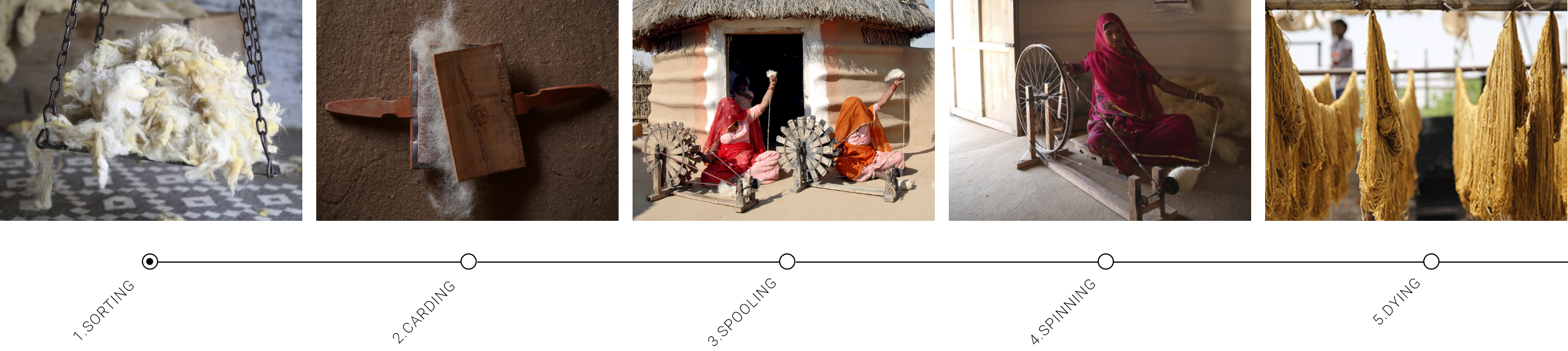
A Tappeti carpet is the sum of countless skilled gestures. Each step is performed by artisans whose mastery has been refined across generations, turning natural materials into pieces that carry history, technique and human touch in every strand.
Carding & Spinning
The journey of a Tappeti carpet begins with the careful carding of raw wool — untangling and aligning each fibre by hand to prepare it for spinning. This initial process sets the foundation for every quality that follows: the texture, the softness, the consistency of the final piece. The wool is then spun into yarn, with the tension and thickness controlled entirely by the artisan's hands and eyes. This is craft in its most elemental form — transforming nature's raw material into something ready to become art.
Dyeing
Before a single knot is tied, colour must be mastered. Our yarns are dyed in small batches using a blend of natural and carefully selected synthetic dyes, each chosen for its depth, fastness and harmony with the palette. The dyeing process is as much an art as a science — achieving the exact tone required for a design demands experience accumulated over years. Tappeti's artisans control every variable: temperature, duration, bath composition — ensuring that every shade is consistent across the entire carpet and faithful to the original design.
Weaving
At the loom, the carpet takes form. Hand-knotted carpets are woven knot by knot — each one tied individually by the artisan's fingers, row by row, across thousands of hours of dedicated work. The density of the pile, the precision of the pattern, the evenness of the weave — all of it depends entirely on the skill and discipline of the weaver. For Tappeti's finest pieces, a single carpet may contain millions of knots, each contributing to a design that will endure for generations.
Washing
Once the weaving is complete, the carpet undergoes its first transformation: washing. This critical process removes the residual fibres, opens the pile and reveals the true depth of colour beneath. Tappeti carpets are washed using traditional methods — carefully controlled water flow, gentle natural cleansers and experienced hands that know how to treat each fibre type without compromise. It is at this stage that a carpet transitions from craft object to something alive — lustrous, vibrant and ready to be finished.
Gultarash
The final stage is Gultarash — the art of hand-carving the pile to define each element of the design. Using precision scissors and blades, our artisans sculpt the surface of the carpet, creating depth, dimension and tactile contrast between pattern and ground. This finishing technique is what gives a Tappeti carpet its distinctive three-dimensional quality: the sense that you are looking not just at a surface, but at something with weight, shadow and life. Gultarash is patience made visible — and it is what separates a carpet from a masterpiece.